

Different Types of Wire Mesh
Wire mesh is a manufactured material consisting of interconnected wires, available in a vast range of patterns, materials, and strengths. It serves critical roles in construction, industry, agriculture, and architecture. Choosing the right type depends on mechanical requirements, environmental conditions, and aesthetic needs. Below are the most common and application-oriented types of wire mesh.
1. Woven Wire Mesh
Woven wire mesh is produced by interlacing warp (lengthwise) and weft (cross) wires over and under each other, similar to textile weaving.
Features:
- Flexible and available in fine to coarse openings
- Various weaves: plain, twill, Dutch, and plain Dutch
- Precise pore sizes allow accurate particle retention
Materials: Stainless steel (304, 316), brass, copper, phosphor bronze, or galvanized iron.
Uses: Liquid and gas filtration, sieving, papermaking, insect screens, and laboratory test sieves.
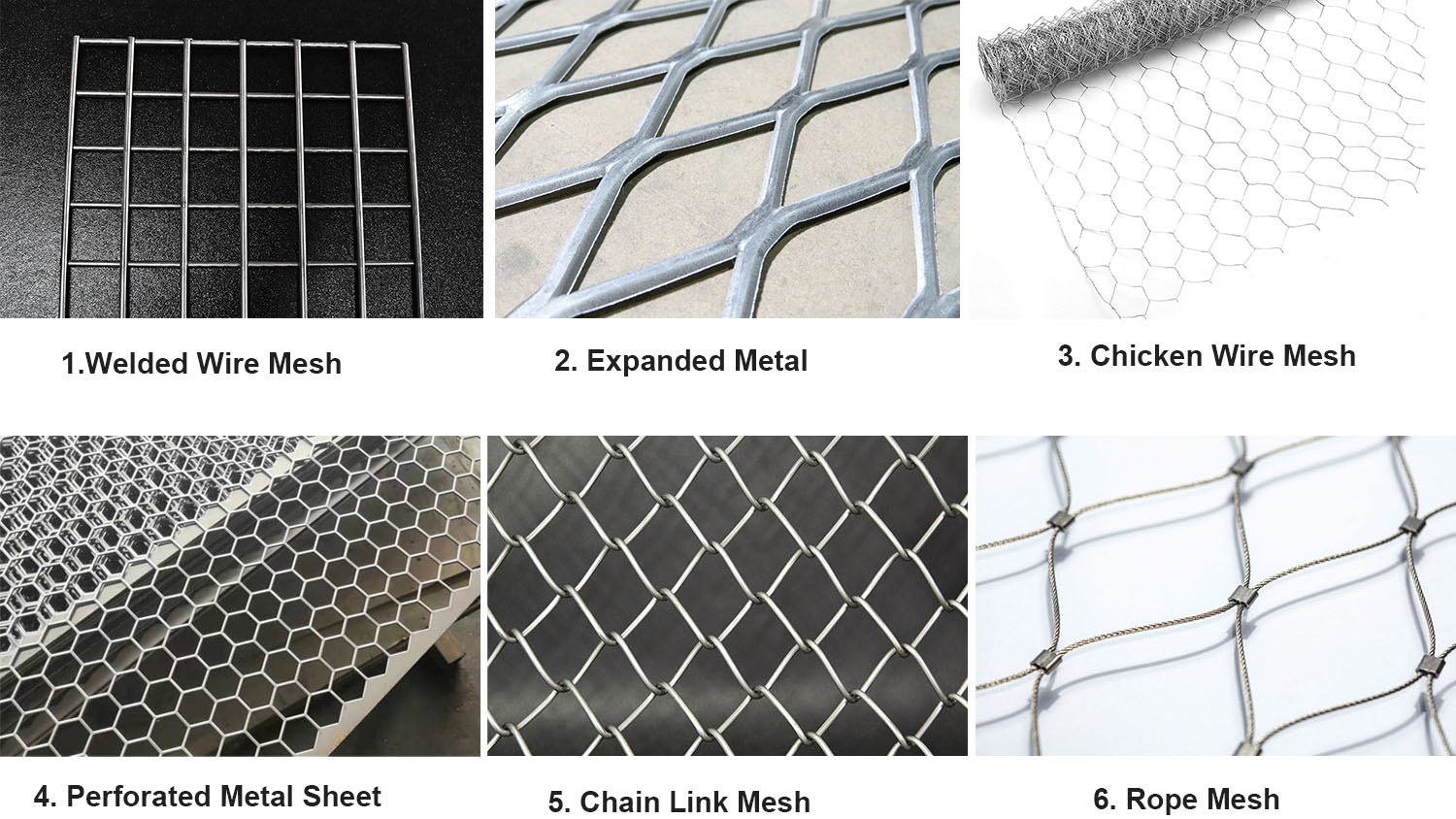
2. Welded Wire Mesh
Welded mesh is made by resistance-welding perpendicular wires at every intersection, forming a rigid panel.
Features:
- Very strong; does not unravel when cut
- Uniform square or rectangular openings
- Can be galvanized or PVC coated for corrosion resistance
Materials: Low-carbon steel, stainless steel, or galvanized steel; also available with PVC coating.
Uses: Concrete reinforcement (slabs, walls), animal cages, industrial partitions, pallet cages, and security fencing.
3. Expanded Metal Mesh
Expanded metal is produced by slitting and stretching a solid metal sheet, creating diamond-shaped openings without cutting away any material.
Features:
- One-piece construction – no welding or weaving
- High strength-to-weight ratio
- Excellent air, light, and liquid flow
- Slip-resistant surface (raised strands)
Materials: Aluminum, carbon steel, stainless steel, galvanized steel, titanium, and copper.
Uses: Walkways, machine guards, catwalks, battery grids, speaker grilles, and fencing.
4. Crimped Wire Mesh
Wires are pre-crimped (corrugated) before weaving, locking intersections to prevent movement.
Features:
- Highly stable under vibration and heavy loads
- Resists shifting and wear
- Available in coarse or fine crimps
Materials: Heavy-gauge stainless steel, mild steel, or high-carbon steel.
Uses: Mining screens, quarrying, heavy-duty sifting, stone washing, and coal classification.
5. Hexagonal Wire Mesh (Chicken Wire)
Twisted wires form six-sided openings, making it flexible and lightweight.
Features:
- Easy to cut and shape by hand
- Rust-resistant when galvanized or PVC coated
- Low cost
Materials: Galvanized steel or PVC-coated steel.
Uses: Poultry enclosures, garden fencing, small animal cages, erosion control, and stucco reinforcement.
6. Architectural Wire Mesh
Architectural wire mesh is a high-end, purpose-made mesh for building interiors and exteriors, combining function with visual appeal.
Features:
- Aesthetic patterns: cables, spirals, or woven strands
- Customizable transparency, color, and rigidity
- Fire-resistant and durable
- Allows natural ventilation and daylighting
Materials: Stainless steel (316L), bronze, brass, copper, or aluminum, often with special coatings.
Uses: Building facades, sunscreens, ceiling panels, balustrade infills, lobby dividers, and stairwell cladding. It is often used in airports, museums, and luxury retail stores.
7. Decorative Wire Mesh
Decorative wire mesh focuses primarily on visual texture, used as an artistic or design element.
Features:
- Available in elegant weaves (e.g., twill, basket weave, or Japanese weaves)
- Can be polished, painted, or powder-coated
- Fine wires and small openings create shimmering effects
Materials: Brass, copper, bronze, aluminum, or mirror-polished stainless steel.
Uses: Room dividers, cabinet doors, fireplace screens, wall art, lamp shades, furniture inlays, and garden sculptures. It is popular in interior design and boutique hotels.
8. Filter Wire Mesh
Filter mesh is a high-precision woven mesh strictly manufactured to retain particles of a specific size.
Features:
- Very tight tolerances (micron ratings)
- Dutch weave or plain Dutch weave for maximum particle retention
- Uniform pore distribution
Materials: Stainless steel 304 or 316, sometimes nickel or Monel for chemical resistance.
Uses: Industrial filters, oil separators, water treatment cartridges, pharmaceutical sieves, and food processing screens.
9. Epoxy-Coated Wire Mesh
Standard welded or woven mesh with an epoxy resin coating for extreme corrosion and chemical resistance.
Features:
- Smooth, seamless finish
- Excellent adhesion and impact resistance
- Available in many colors (black, grey, green, etc.)
Materials: Low-carbon steel core + epoxy coating.
Uses: Refrigerated warehouse partitions, swimming pool fencing, chemical plant safety screens, and laboratory animal cages.
10. Perforated Metal Mesh
While not strictly “wire” mesh, perforated metal is often grouped with it. It is made by punching holes into a solid sheet. Uses include acoustic panels, radiator grilles, ventilation covers, and decorative screens.
From heavy-duty mining screens to elegant decorative panels, wire mesh comes in countless forms. Woven, welded, expanded, and crimped meshes serve structural and industrial needs, while architectural and decorative meshes bring form and function to modern design. Filter meshes achieve precise separation, and coated types add longevity in harsh environments. Selecting the correct type ensures safety, efficiency, and aesthetic success in any project.